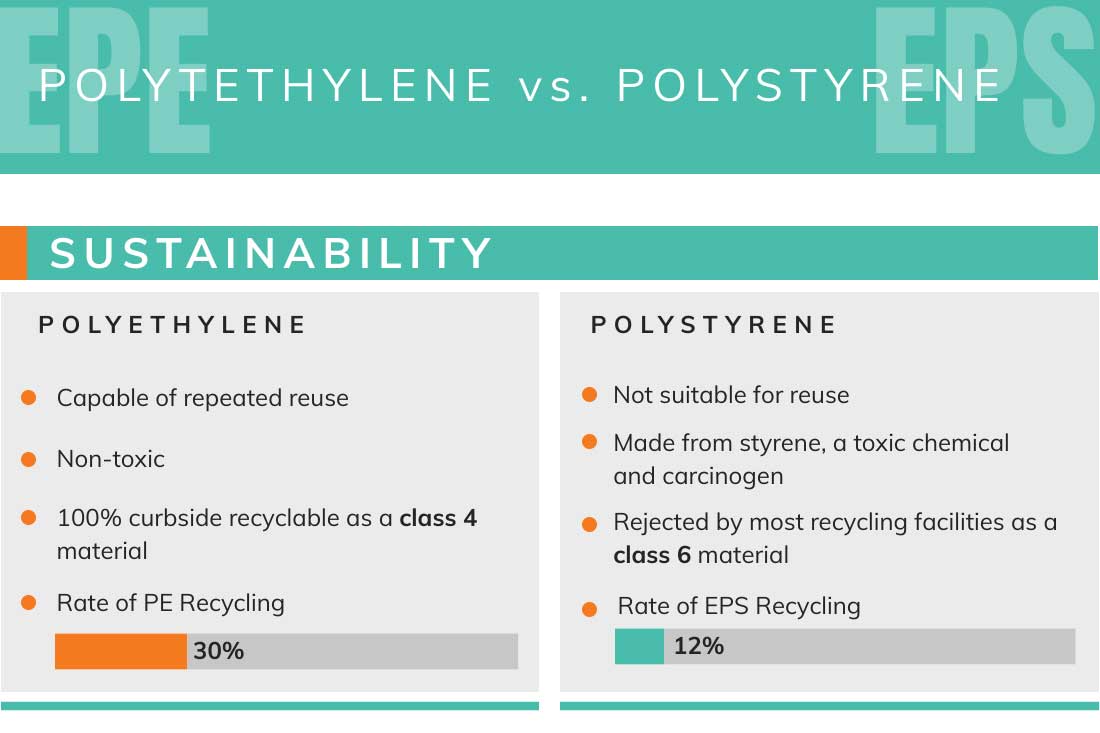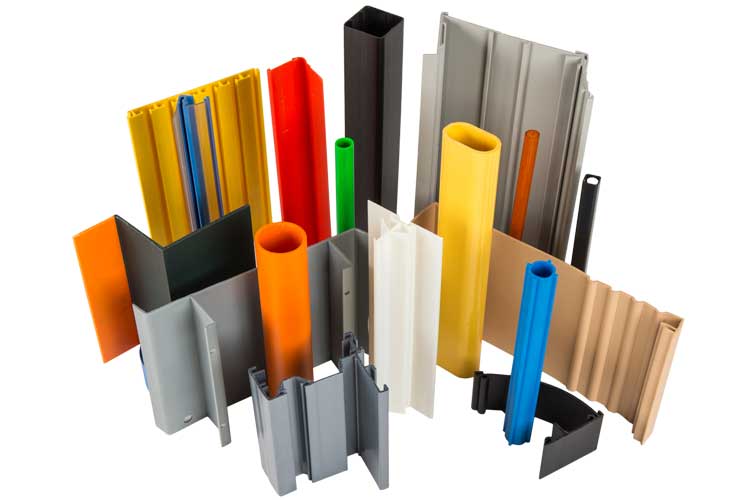
Many parts exposed to acids, alkalis, solvents, oils, detergents and disinfectants will be plastic and the chemical resistance of the plastic will vary during use. The plastic may be stable at low concentrations and at room temperature. As the concentration of any chemical, temperature, contact time and/or mechanical stress increases, swelling, softening, cracking or strength decreases can happen.
Holly’s article includes the most common chemical resistant plastics: PP, HDPE, PVDF, PTFE, PPS and PEEK, and their respective compatibility with the various chemical media, along with their applications in medical or laboratory parts.
1 What is chemical-resistant plastic?
Chemical-Resistant Plastics are plastics that are capable of retaining their primary physical characteristics, mechanical characteristics and dimensional stability when tested against specific chemicals and under specific conditions and times of use.
The common failures of plastics caused by the chemical media include: chemical degradation, which causes the polymer molecular chain to be broken and leads to material change in colour, become brittle or become less strong; swelling and dissolution, which causes the material to soften and change its size; and environmental stress cracking (ESC), which causes cracks in the material with no obvious swelling or corrosion, but under the action of chemical media and mechanical force.
2 Common chemical-resistant plastics
The most common chemical-resistant plastics used are PP, HDPE, PVDF, PTFE, PPS and PEEK.
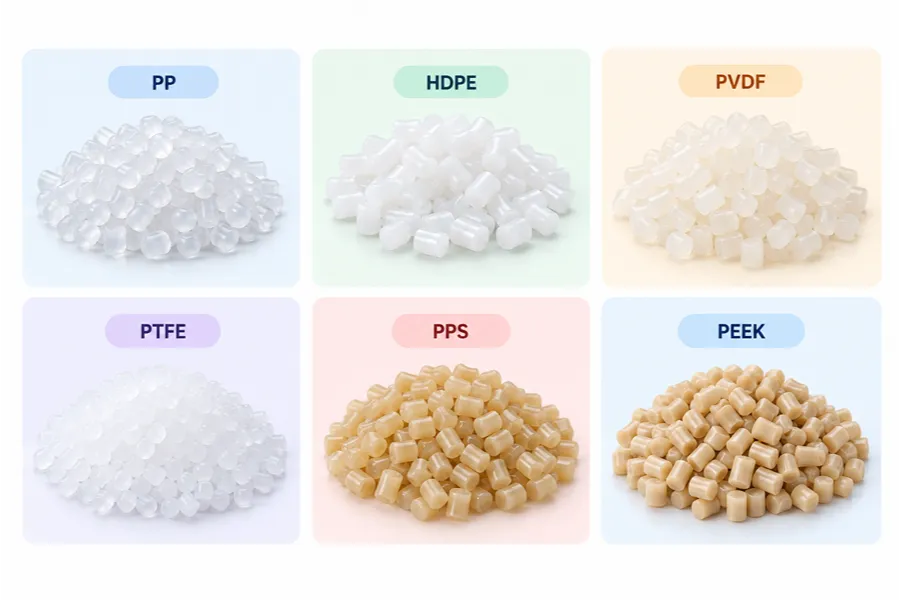
Common Chemical-Resistant Plastics
1)Polypropylene (PP)
Polypropylene (PP) is a thermoplastic polymer, a semi-crystalline polymer and is a widely used chemical resistant material. PP has good tolerance to most dilute acids, alkalis, salt solutions and a variety of detergents. It has low water absorption, density of approximately 0.90 g/cm³, low cost, and is easy to injection mold.
PP has low resistance to high temperature, low high-temperature rigidity, and low tolerance for some strong oxidants, aromatic hydrocarbons and halogenated hydrocarbons. When the temperature increases, creep and size changes should also be considered.
2)Polyethylene (PE / HDPE)
Polyethylene (PE) exists in thermoplastic semi-crystalline form, among which the high-density polyethylene (HDPE) is the one with high density and crystallinity, and this is one of the most commonly used types of PE for parts which are resistant to chemicals.
HDPE is resistant to most acid, alkali and salt solutions, with a low water absorption rate, is tough and impact resistant. It is not very heat resistant; its rigidity and dimensional stability are relatively poor; some hydrocarbons and strong oxidizing chemicals must be handled with caution.
3)Polyvinylidene Fluoride (PVDF)
Polyvinylidene Fluoride (PVDF) is a semi-crystalline thermoplastic plastic containing fluorine, which is a fluoropolymer. It has good tolerance to most acids, alkalis, halogens and a variety of corrosive chemical media, as well as good heat resistance, mechanical strength and weather resistance.
PVDF has limited resistance to some ketone, ester and amine media and the material price is significantly higher than that of PP and HDPE.
4)Polytetrafluoroethylene (PTFE)
The polymer of interest, polytetrafluoroethylene (PTFE), is a very fluorinated polymer with outstanding chemical inertness. It possesses a good high temperature resistance, low friction coefficient, and is resistant to most acids, alkalis and organic solvents, and has a low water absorption rate.
PTFE has a relatively low rigidity and creep resistance, and the melt viscosity of PTFE is very high. It can’t be made using the traditional melt injection molding technique used for PP, PVDF, PPS and PEEK.
5)Polyphenylene sulfide (PPS)
Polyphenylene sulfide (PPS) is a high performance engineering plastic that is made in a semi-crystalline form. Meanwhile it has high rigidity, low water absorption, dimensional stability, is resistant to various acids and alkalis and is resistant to fuel and organic solvents, with a melting point of approximately 280℃. It is not tough, has poor impact resistance and is prone to breakage under large impact or local stress.
6)Polyether ether ketone (PEEK)
One of the high performance thermoplastic engineering plastics of the PAEK polymer family is polyether ether ketone (PEEK) of semi-crystalline type. Has good resistance to chemicals, high temperature resistance, mechanical strength, fatigue resistance and dimensional stability. Melting point is approximately 343℃ and the continuous use temperature is approximately 250℃. Not very tolerant to a few strong corrosive media e.g., concentrated sulphuric acid.
3 Compatibility of different chemical media and plastics
Different chemical media have different effects on plastics. Material compatibility with acids, alkalis, organic solvents, oils and disinfectants needs to be evaluated separately.
1)Acid environment
Acid media are hydrochloric acid, sulfuric acid, nitric acid, phosphoric acid and organic acids, etc. PP, HDPE, PVDF and PTFE are all resistant to many acidic media and PVDF and PTFE can generally be used in more corrosive environments. PPS and PEEK have good tolerance to a variety of acids.
2)Alkaline environment
Sodium hydroxide, Potassium hydroxide, Ammonia, Alkaline cleaning solution, etc. are alkaline environments. PP, HDPE, PTFE, PPS, PEEK have good tolerance to the majority of alkaline environments, and PVDF has limited tolerance to some strong alkalis.
For example, Potassium Lye (KOH) is tolerated by PP, PE, PTFE, PPS and PEEK in 10% and 50% aqueous solutions, but is conditionally tolerated in both concentrations for PVDF.
3)Organic solvents
PTFE, PEEK and PPS have a wide tolerance range for various types of organic solvents, and different types of organic solvents will affect the performance of PP, HDPE and PVDF.
For instance, PP, PE, PVDF, PTFE, PPS and PEEK are all listed as tolerant when exposed to Isopropanol (IPA), but when changed to Acetone, PP, PE, PPS, PTFE and PEEK are still listed as tolerant, however, PVDF is listed as conditionally tolerant. If it is changed to Butyl Acetate, PVDF is listed as intolerant.
4)Oil, fuel and lubricant
This category of media includes diesel, fuel oil, gasoline, hydraulic oil and lubricating oil. PEEK, PPS, PVDF and PTFE have good tolerance to a variety of fuels and oils, and the performance of PP and PE will change with specific media.
Take Diesel Oil as an example, PE, PVDF, PTFE, PPS and PEEK are all listed as tolerant, while PP is conditionally tolerant; in Fuel Oil, PE, PVDF, PTFE, PPS and PEEK are listed as tolerant, and PP is conditionally tolerant.
5)Detergents and disinfectants
Common cleaning and disinfection media for medical and laboratory equipment include Ethanol, IPA, Hydrogen Peroxide, Sodium Hypochlorite and Quaternary Ammonium Compounds. PP, PE, PVDF, PTFE, PPS and PEEK have good tolerance to many common cleaning media.
For example, when exposed to 96% Ethanol, PP, PE, PVDF, PTFE, PPS and PEEK are all listed as tolerant; but for Alcoholic Iodine Solution, PP, PE, PVDF and PTFE are listed as tolerant, while PEEK is conditionally tolerant.
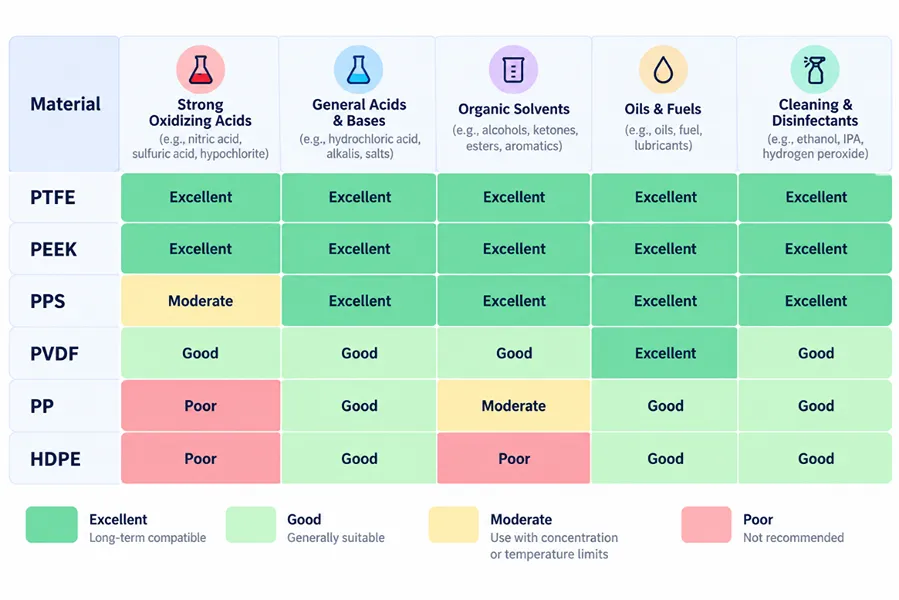
List of compatibility between media and plastics
4 Key factors affecting the chemical resistance of plastics
Chemical compatibility will change with concentration, temperature, contact time and mechanical stress, and different plastics have different degrees of sensitivity to these factors.
1)Chemical concentration
Concentration changes are especially obvious for strong acids, strong alkalis and strong oxidants.
| Material | A typical medium that is sensitive to concentration changes | The main changes after the concentration increases |
| PP | Strong oxidizing acids, aromatic hydrocarbons, halogenated hydrocarbons | Swelling, softening or performance decline |
| HDPE | Strong oxidizing acids, some hydrocarbons | Oxidation, swelling, mechanical performance decline |
| PVDF | Strong base, partial amines | Defluorination, discoloration, embrittlement, strength decrease |
| PTFE | Most common acids, alkalis and solvents | The influence of concentration is relatively small, except for a few extreme media. |
| PPS | Strong oxidizing medium | Oxidation and mechanical properties decline |
| PEEK | Strong acids such as concentrated sulfuric acid | Surface erosion, swelling and even loss of material integrity |
2)Working temperature
The increase in temperature will not only accelerate the chemical reaction, but also increase the diffusion rate of chemical media in polymers, and reduce the rigidity of some thermoplastics, so chemical erosion is usually accelerated.
| Material | Typical continuous use temperature | The main impact of rising temperature |
| PP | About 80–100°C | The rigidity and creep resistance decrease, and the swelling and size change accelerate. |
| HDPE | About 60–80°C | The rigidity decreases, and the swelling caused by hydrocarbons and other media is more obvious. |
| PVDF | About 140–150°C | The temperature resistance is higher than that of PP and HDPE, but high-temperature strong alkali will accelerate chemical degradation. |
| PTFE | About 260°C | There is still strong chemical stability at high temperature, but creep and deformation increase. |
| PPS | About 200–220°C | It can still maintain good chemical resistance and dimensional stability at high temperatures. |
| PEEK | About 250°C | It can still maintain high mechanical strength, chemical resistance and dimensional stability at high temperatures. |
3)Contact time
After the contact time is extended, the medium can further diffuse into the polymer, so that the swelling, weight change and mechanical property decline gradually increase. The long-term performance of different materials is also different:
| Material | Issues to focus on during long-term contact |
| PP | Swelling caused by hydrocarbons and creep under high temperature |
| HDPE | Hydrocarbon absorption, swelling and size change |
| PVDF | Performance degradation during long-term exposure to strong alkalis, some amines and other incompatible media |
| PTFE | Chemical degradation is usually less, and more attention should be paid to penetration and creep. |
| PPS | Long-term performance changes in strong oxidation environment |
| PEEK | Continuous erosion in incompatible media such as strong acids |
4)Mechanical stress and environmental stress cracking (ESC)
Mechanical stress will not directly change the concentration of chemicals, but it will reduce the ability of some plastics to resist chemical media. After the chemical medium enters the stressed area, it will promote the formation and expansion of microcracks, and eventually form Environmental Stress Cracking.
| Material | The main risks of being subjected to force and exposure to chemicals |
| PP | ESC may occur under certain surfactants, oxidants and organic media. |
| HDPE | Sensitive to ESC, detergents, surfactants and other environments need special attention. |
| PVDF | The overall resistance to ESC is good, but the combination of strong alkali, high temperature and continuous stress may still crack. |
| PTFE | The risk of chemically induced ESC is low, and it is necessary to pay more attention to creep under long-term load. |
| PPS | Chemical resistance and dimensional stability are good, but brittle failure may still occur in high stress positions. |
| PEEK | It has strong ESC resistance, but it cannot make up for the incompatibility between the material and the medium itself. |
5 Selection of chemical-resistant plastics in medical and laboratory equipment
Different equipment comes into contact with different chemical media and working conditions, and the commonly used chemical-resistant plastics are also different.
1)Medical and diagnostic equipment
Common components include reagent kits, sample cups, pipette parts, reagent pipeline joints, internal fluid parts of the analyzer, disinfectant containers and equipment shells. It is mainly in contact with blood, buffer, acid-base reagent, ethanol, IPA, hypochlorite and other cleaning disinfectants.
- Room temperature, low-load reagent containers and disposable fluid components: PP, HDPE
- Joints, valve bodies and fluid components in long-term contact with acid-base reagents: PVDF
- Fluid parts with high temperature and high mechanical strength required: PPS, PEEK
- Strong corrosion medium seal, valve seat: PTFE
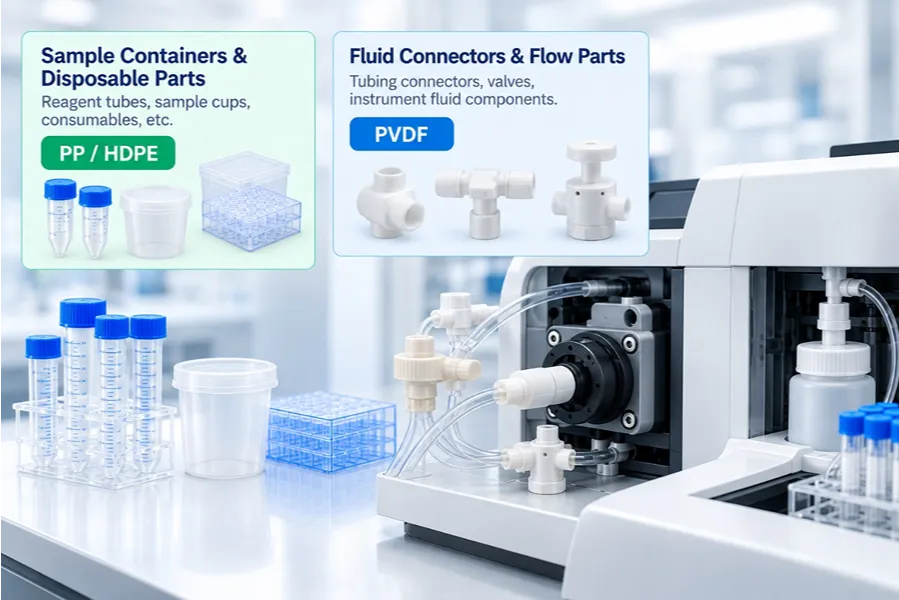
Medical and Diagnostic Equipment
2)Laboratory and analytical instruments
Common equipment includes chromatographs, spectrometers, automatic samplers, laboratory analyzers, reagent distribution equipment, laboratory pumps and liquid processing systems. Internal parts may be exposed to acids, alkalis, ethanol, IPA, Acetone, buffers and different organic solvents for a long time.
- Room-temperature aqueous solution, dilute acid and alkali containers: PP, HDPE
- Acid-base reagent pipeline joints and pump valve parts: PVDF
- Fluid components that come into contact with multiple organic solvents at the same time: PTFE
- Structural parts that require solvent resistance + rigidity + dimensional accuracy: PPS, PEEK
- High-temperature and high-pressure analyzer fluid components: PEEK
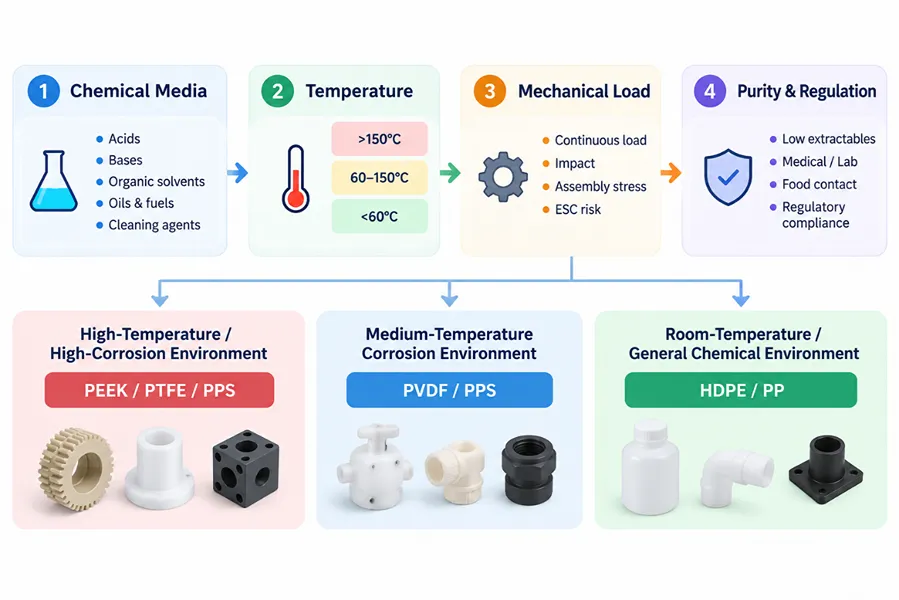
Selection of chemical-resistant plastics
6 Conclusion
Chemically resistant plastics PP and HDPE are suitable for many normal temperature acid-base and low-load fluid components; PVDF and PTFE can cover stronger corrosive media; PPS and PEEK are more suitable for parts with high temperature, high strength and high size stability requirements.
Holly provides PP, PE, PVDF, PPS and PEEK injection molding services, and can produce reagent joints, fluid components, pump and valve parts and precision structural parts in medical diagnostic equipment and laboratory instruments. Send your 3D drawings, materials and media, and we can provide a quotation for injection molding for the project.