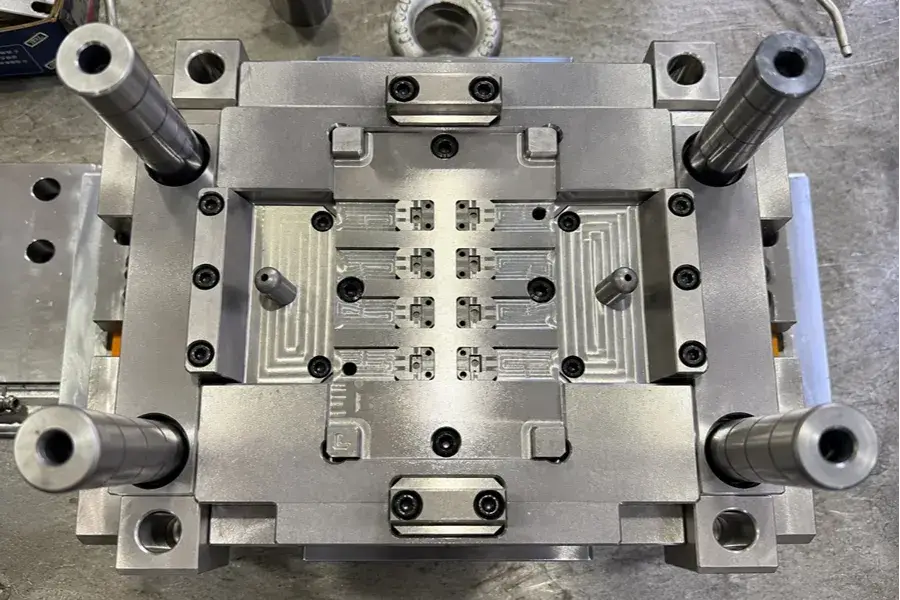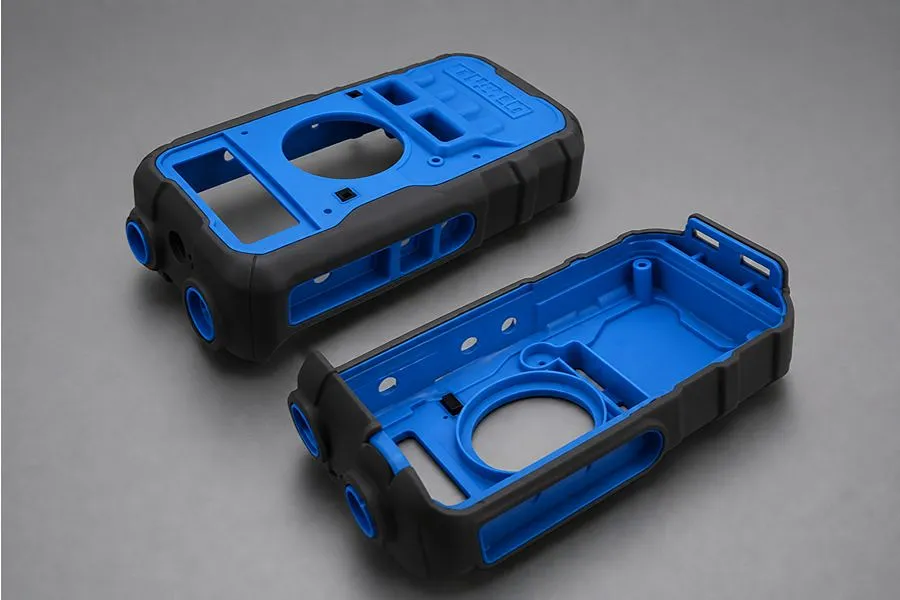
One of the highest first costs in the development of plastic products is injection mold cost. The cost of the mold can vary from a few thousand dollars to hundreds of thousands of dollars, depending on the size, design, life of the mold, precision required, and production volume.
This article will examine the subjects of typical ranges of injection mold prices, key factors that will influence the pricing of injection molds, major cost components of injection molds, practical ways to cut costs, and real-world, cost examples that will enable the buyer to better assess quotes.
This pricing reference mainly covers North America and Europe. China-based mold costs are usually lower and will be discussed separately in a China vs. Western mold cost comparison.
1. Injection Mold Price Reference Ranges
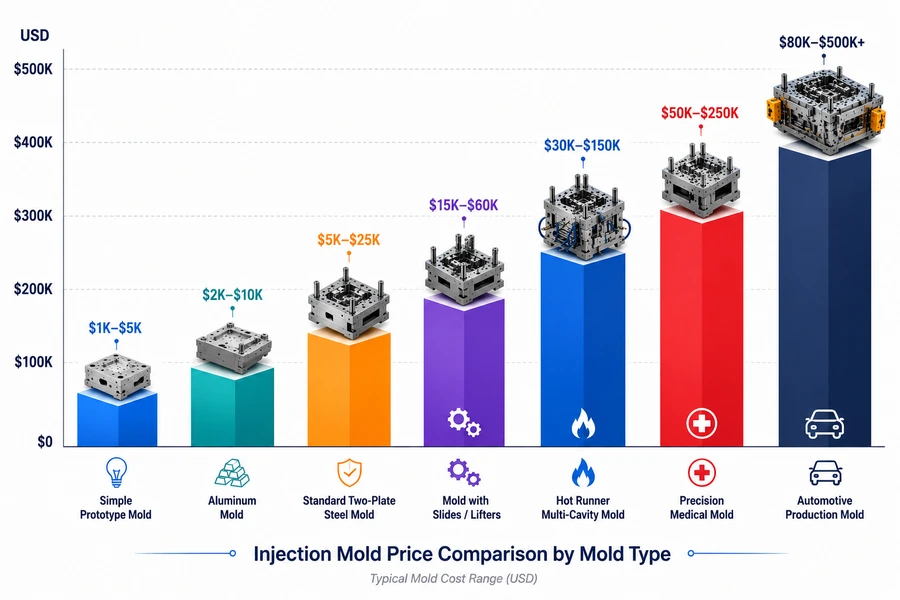
The following table presents reference price ranges for injection molds, categorized by mold type, size/structure, price range, typical mold life, and typical applications.
1) By Mold Type
Different mold types are suitable for different production stages, from prototype testing to high-volume manufacturing. This table gives a quick comparison of their typical cost levels and applications.
| Mold Type | Size / Structure | Price Range (USD) | Typical Mold Life | Typical Applications |
| Simple Prototype Mold | Small, simple structure | $1,000–$5,000 | 500–5,000 shots | Prototyping, design validation |
| Aluminum Mold | Small to medium size, low volume | $2,000–$10,000 | 1,000–10,000+ shots | Low-volume production |
| Standard Two-Plate Steel Mold | Small to medium size, P20/718H | $5,000–$25,000 | 100,000–500,000 shots | Housings, consumer products, industrial parts |
| Mold with Slides / Lifters | Medium size with undercuts | $15,000–$60,000 | 300,000–800,000 shots | Electronic housings, structural components |
| Hot Runner Multi-Cavity Mold | Medium to large size, multi-cavity | $30,000–$150,000+ | 500,000–1,000,000+ shots | Connectors, caps, medical consumables |
| Precision Medical Mold | High precision, validated tooling | $50,000–$250,000+ | 1,000,000+ shots | Medical housings, disposable devices |
| Automotive Production Mold | Large, complex structure | $80,000–$500,000+ | 500,000–1,000,000+ shots | Automotive interior, exterior, structural parts |
2) By Industry
The following is categorized by industry:
| Industry | Typical Price Range (USD) |
| Consumer Goods / Small Plastic Parts | $3,000–$20,000 |
| Consumer Electronics Housings | $8,000–$50,000 |
| Industrial Components | $10,000–$80,000 |
| Medical Plastic Parts | $30,000–$250,000+ |
| Automotive Interior / Structural Parts | $50,000–$500,000+ |
| Precision Connectors / Multi-Cavity Components | $30,000–$200,000+ |
| Optical Transparent Parts | $50,000–$300,000+ |
2. Core Components of Injection Mold Costs
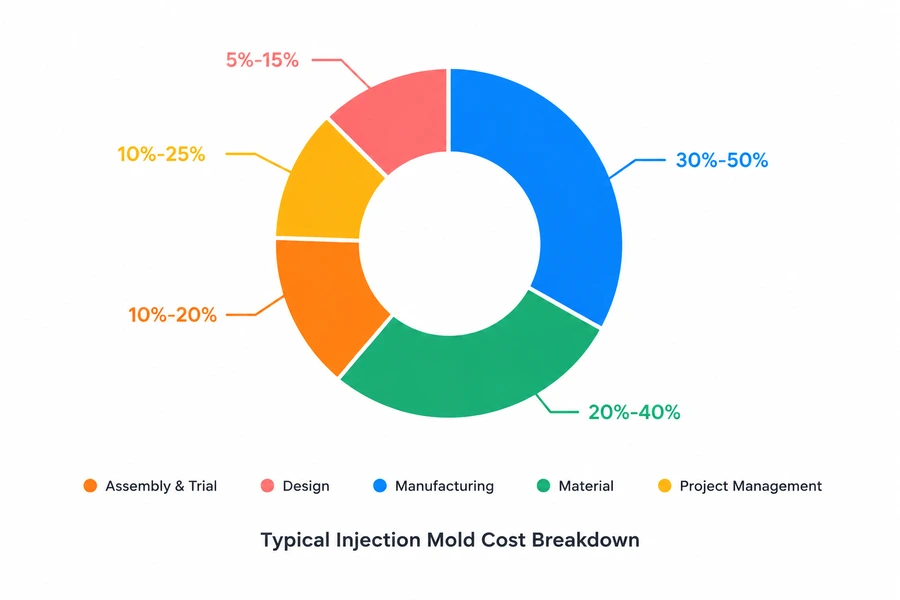
Injection mold costs are generally calculated as: Material Cost + Design Cost + Manufacturing Cost + Assembly & Trial Cost + Project Management & Profit
1) Mold Material Cost (20%–40%)
Material costs typically include mold steel, mold base, and standard components, all of which directly affect mold life, accuracy, and production stability.
a. Mold Steel
Let’s look at the parameter table of mold steel first.
| Steel Grade | Typical Application | Typical Mold Life | Cost Level |
| P20 | Standard industrial parts, low-to-medium volume | 100,000–500,000 shots | Economical |
| 718H | Medium-volume industrial parts, housings | 300,000–800,000 shots | Moderate |
| NAK80 | High-polish cosmetic and transparent parts | 300,000–500,000 shots | Medium-High |
| H13 | High-temperature, glass-filled materials | 500,000–1,000,000 shots | High |
| S136 / STAVAX | Medical, transparent, corrosion-resistant molds | 500,000–1,000,000+ shots | High |
P20 or 718H is adequate for small to medium volume projects. The steels typically used in products that demand glass-filled material, corrosive resin, mirror polish, transparency or medical-grade surfaces are H13, S136 or equivalent.
b. Mold Base and Standard Components: For small and medium molds, mold bases and standard components typically cost between $1,000–$8,000. Large or high-precision mold bases may cost $10,000–$30,000+.
c. Hot Runner Systems
Hot Runner Systems including Single-Point, 2–4 Cavity Hot Runner and Multi-Cavity Valve Gate System.
| Hot Runner Type | Additional Cost |
| Single-Point Hot Runner | $2,000–$5,000 |
| 2–4 Cavity Hot Runner | $5,000–$15,000 |
| Multi-Cavity Valve Gate System | $15,000–$50,000+ |
2) Mold Design Cost (5%–15%)
Mold design is usually calculated as: Design Hours × Engineer Hourly Rate
a. Typical Engineering Rates
Understanding the typical engineering fees for mold designers and tooling engineers in North America and Europe is important prior to estimating mold design costs.
| Engineering Service | Typical North America / Europe Rate |
| Standard Mold Design | $50–$100/hour |
| Senior Mold Engineer | $100–$200+/hour |
| DFM / Mold Flow Analysis | $100–$250+/hour |
b. Typical Design Hours
Engineering rates alone do not determine the final design cost. The total number of design hours required for a mold project is equally important.
| Mold Type | Design Hours |
| Simple Two-Plate Mold | 8–20 hours |
| Standard Industrial Mold with Slides/Lifters | 20–50 hours |
| Multi-Cavity or Hot Runner Mold | 50–150 hours |
| Medical / Automotive Precision Mold | 100–300+ hours |
Design costs may therefore range from $500–$2,000 for simple projects to $5,000–$60,000+ for highly complex programs.
3) Manufacturing Cost (30%–50%)
Manufacturing costs are often the largest portion of total mold cost and include CNC machining, EDM, wire cutting, grinding, polishing, and heat treatment.
a. Typical Machining Rates
The following table shows the typical machining rates used in mold manufacturing, helping you understand where tooling costs come from.
| Process | Typical Rate | Application |
| 3-Axis CNC Roughing | $40–$80/hour | Mold base and cavity rough machining |
| High-Speed CNC Finishing | $60–$120/hour | Precision cavity machining |
| 5-Axis Precision Machining | $100–$200+/hour | Complex surfaces, medical and automotive molds |
| EDM | $40–$150/hour | Deep cavities, sharp corners, intricate details |
| Wire EDM | $50–$120/hour | Inserts, ejector holes, precision features |
| Precision Grinding | $60–$150/hour | Parting surfaces and fitting surfaces |
| Polishing | $50–$120/hour | Cosmetic, mirror, and high-gloss surfaces |
| Heat Treatment | Batch or weight-based pricing | Hardening and tempering |
b. Typical Processing Hours
The higher the level of complexity of the mold, the more CNC machines, EDM and finishing processes will be used and the more expensive it will become to produce the mold.
| Mold Complexity | CNC Hours | EDM Hours | Grinding / Polishing Hours |
| Simple Two-Plate Mold | 20–40 | 5–15 | 5–15 |
| Standard Industrial Mold | 40–100 | 15–50 | 10–30 |
| Slide/Lifter Complex Mold | 80–200 | 30–100 | 20–80 |
| Medical / Automotive Precision Mold | 200–500+ | 80–200+ | 80–300+ |
This is what makes it so difficult to get quotes from different suppliers to the same mould. The distinction is not only in the material itself but also in the capability of the machine, the number of hours it takes, the quality of polishing, the standards for inspection, and the validation services it provides.
4) Assembly and Mold Trial Cost (10%–20%)
Typical mold trial costs include machine time, material consumption, labor, and testing.
| Item | Typical Cost |
| Small Mold Trial | $500–$1,500 per trial |
| Medium Mold Trial | $1,500–$5,000 per trial |
| Large Mold Trial | $5,000–$15,000+ per trial |
| Minor Modification | $500–$3,000 |
| Major Engineering Change | $3,000–$20,000+ |
Most molds require at least a T1 trial. Complex projects may require T2, T3, or additional validation rounds.
5) Project Management, Quality Control, and Profit (10%–25%)
Quotations typically include:
- Project management
- Quality inspection
- Engineering communication
- Equipment depreciation
- Facility and utility costs
- Supplier profit
- Risk contingency
In medical, automotive, aerospace, optical and other highly regulated industries, this percentage tends to be higher.
3. Key Factors Affecting Injection Mold Prices
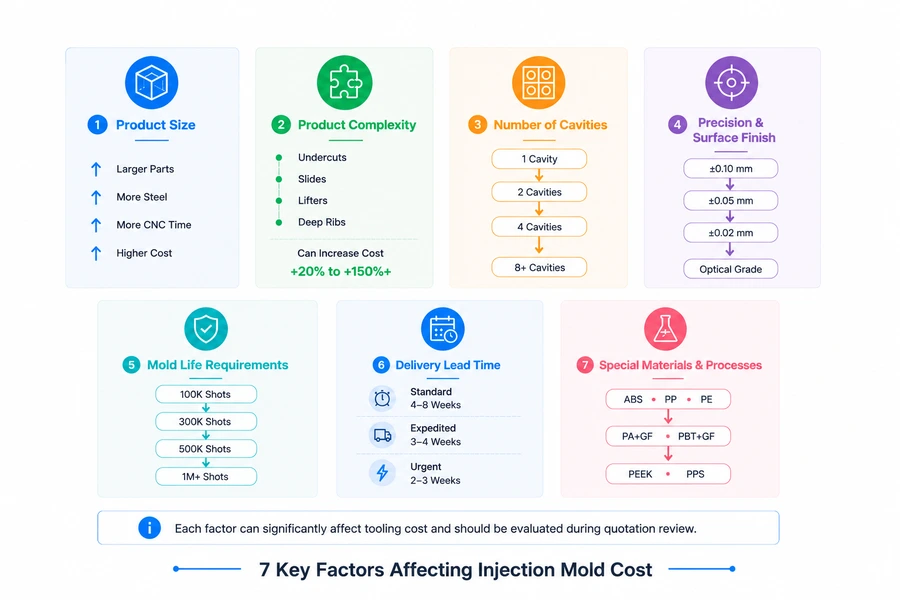
The size of the mold is not the only factor that determines the cost of injection mold. For many projects, you can find two similar size molds priced widely apart due to the fact that the internal structure, cavity number, tolerances, surface finish, mold life, and delivery dates are all different.
The percentages listed below are industry estimates. They are primarily used to describe the effects of each of the factors on tooling cost and are not to be mechanically added together.
Product size, part complexity, number of cavities, precision requirements, mold life, lead time and special materials or processes are the most important cost factors. When reviewing mold quotes, buyers should not just look at the price, but consider all of these factors.
A basic single-cavity mold for a simple plastic housing, for instance, can be achieved with basic CNC machining and polishing. However a precision medical or automotive mold might need multi-cavity design, hardened steel, EDM machining, close control of tolerances, analysis of mould flow and repeated trial adjustments.
That’s why a cheap mold is not always a worthwhile purchase. If the quotation is not clearly explained about the mold structure, steel grade, cavity number, tolerance, mold life etc., the cost may be raised later, which can be due to modification charges, delivery delay, or unstable production quality.
1) Product Size
Product size directly affects mold base size, steel usage, machining travel, and overall mold cost. Under the same structure, cavity quantity, and material conditions, larger parts require more steel, more CNC time, longer heat treatment, and more polishing work.
As a rule, the cost of the same type of mold could be 25%-45% more expensive when the total product size grows by 50%. If the parts are extremely large (more than 1000 mm), large gantry CNC machines and high-tonnage injection molding machines could be needed, adding to the cost.
2) Product Complexity
Product complexity is one of the most important cost drivers.
| Product Structure | Cost Impact |
| Simple flat / cylindrical structure, no undercuts | Baseline cost |
| Shallow undercuts or simple side holes | +20%–40% |
| Multiple undercuts, deep ribs, internal threads | +40%–80% |
| Multiple core pulls, rotating mechanisms, complex 3D surfaces | +80%–150%+ |
A simple two-plate mold may cost only $5,000–$15,000. However, once multiple slides, lifters, deep cavities, and complex surfaces are added, the cost can easily rise to $25,000–$80,000+.
3) Number of Cavities
The number of cavities increases mold manufacturing cost but can reduce the unit production cost later.
| Number of Cavities | Mold Cost Change | Suitable Application |
| 1 cavity | Baseline | Low volume, new product validation |
| 2 cavities | +30%–60% | Low-to-medium volume production |
| 4 cavities | +60%–120% | Medium-volume production |
| 8 cavities or more | +100%–250%+ | High-volume production |
| Multi-cavity hot runner | Highest cost | High-volume, low unit cost projects |
More cavities also increase the difficulty of mold balance, cooling design, hot runner control, precision machining, and mold trial adjustment.
4) Precision and Surface Requirements
| Requirement Level | Cost Impact |
| Standard industrial tolerance ±0.10 mm | Baseline |
| Precision tolerance ±0.05 mm | +15%–30% |
| High-precision tolerance ±0.02 mm | +30%–80% |
| Medical / Optical grade ±0.01 mm | +50%–150%+ |
Surface finish requirements also affect cost. For example:
| Surface Requirement | Cost Impact |
| Standard machined surface | Lowest cost |
| EDM texture / VDI texture | Moderate |
| SPI B-grade polish | Higher cost |
| SPI A1 mirror polish | Significant cost increase |
| Optical-grade transparent surface | Highest cost |
Completely manual polishing and precise inspection is typically needed for mirror polish, cosmetic surfaces and transparent components.
5) Mold Life Requirements
| Mold Life Requirement | Common Steel | Cost Impact |
| Below 100,000 shots | P20 / 718H | Baseline |
| 300,000–500,000 shots | 718H / NAK80 | +15%–30% |
| 500,000–1,000,000 shots | H13 / S136 | +30%–60% |
| Over 1,000,000 shots | High-hardness / specially treated steel | +50%–100%+ |
The higher the mold life requirement, the higher the steel grade, heat treatment, machining accuracy and maintenance requirement.
6) Delivery Lead Time
| Lead Time Requirement | Cost Impact |
| Standard lead time: 4–8 weeks | Baseline |
| Expedited: 3–4 weeks | +10%–25% |
| Urgent: 2–3 weeks | +25%–50%+ |
Expedited mold projects require priority scheduling, overtime machining, and compressed trial schedules, so the price is usually higher.
7) Special Materials and Processes
| Material / Process | Cost Impact |
| ABS / PP / PE + cold runner | Baseline |
| PC / POM | Higher temperature control and venting requirements |
| PVC | Corrosion-resistant steel required, +20%–30% |
| PA+GF / PBT+GF | Higher wear, wear-resistant steel required, +30%–50% |
| PEEK / PPS | High-temperature materials requiring high-grade steel and temperature control |
| Hot runner instead of cold runner | +30%–100%+ |
Glass-filled materials and high-temperature engineering plastics usually increase mold cost significantly.
4. Cost Reduction Strategies for Injection Molds
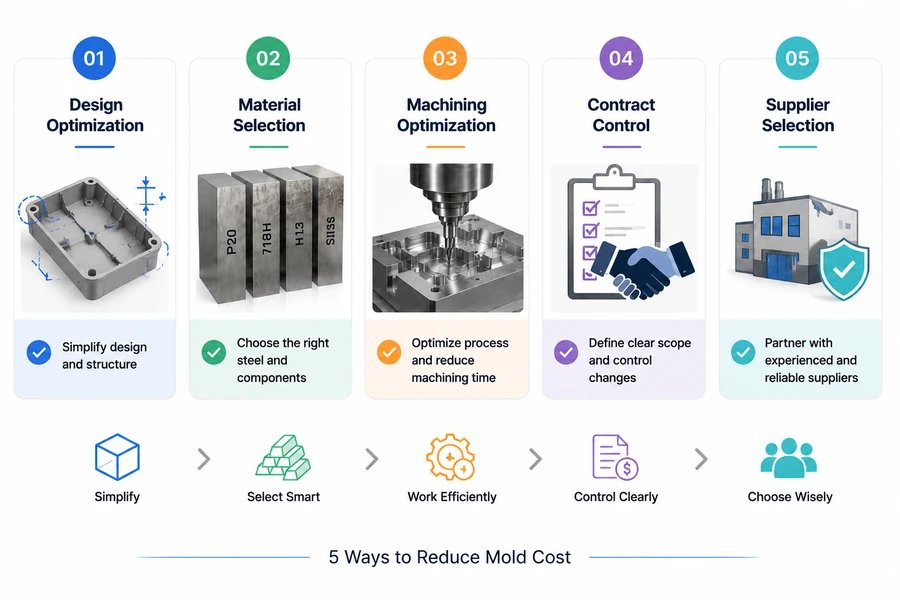
Each cost-saving method is based on a different cost item and should be calculated separately. The savings should not be directly added together. In most projects, reasonable optimization can usually reduce the total mold cost by 10%–30%.
1) Product Design Optimization
Product design optimization is one of the most effective ways to reduce cost at the source. It can usually reduce total mold cost by 8%–15%, and sometimes more for complex projects.
Common methods include:
- Reducing undercuts
- Reducing deep cavities and thin-wall structures
- Prioritizing two-plate mold structures
- Avoiding complex slides and lifters
- Relaxing non-critical tolerances to ±0.10 mm
- Reducing wall thickness variation to avoid sink marks and deformation
- Reducing unnecessary oversized areas while maintaining assembly requirements
2) Reasonable Material Selection
Material optimization mainly affects the material cost item. Since material cost usually accounts for 20%–40% of the total mold price, proper material selection may reduce material cost by 10%–25%.
Common methods include:
- Selecting P20 or 718H for low- to medium-volume projects
- Avoiding unnecessary use of H13, S136, or other high-grade steels
- Selecting steel based on actual mold life requirements
- Using standard mold bases whenever possible
- Using standard ejector pins, guide pins, springs, and other standard components
For example, if the material cost is $10,000, optimization may save $1,000–$2,500, which may reduce the total mold cost by about 3%–10%.
3) Machining Process Optimization
Machining optimization mainly affects machining cost. Since machining cost usually accounts for 30%–50% of the total mold price, reasonable process optimization may reduce machining cost by 10%–20%.
Common methods include:
- Reducing EDM where CNC machining is possible
- Avoiding overly deep or narrow ribs
- Avoiding high-level polishing on non-cosmetic surfaces
- Separating cosmetic and non-cosmetic surface standards
- Avoiding excessive precision tolerances
- Using DFM analysis early to reduce trial modification rounds
For example, if machining cost is $20,000, optimization may save $2,000–$4,000, which may reduce the total mold cost by about 5%–10%.
4) Contract and Schedule Control
Contract and schedule control mainly reduces additional surcharge costs. It does not necessarily lower the base mold’s costs, but it can save you from additional costs later in the process.
Common methods include:
- Avoiding unnecessary expedited schedules to reduce 10%–50%+ urgent fees
- Defining free T1/T2 trial terms clearly
- Clarifying who pays for raw material and machine trial costs
- Defining charges for customer design changes and mold design defects
- Communicating payment items like deposit, sample approval payment, final balance etc.
- Defining responsibilities for mold maintenance, warranties and mold transport
5) Supplier Selection
Supplier selection can usually affect total mold cost by 10%–20%, but the lowest price should not be the only criterion.
A reasonable approach includes:
- Choosing cost-effective specialized mold makers for small and medium molds
- Choosing suppliers with matching equipment and validation capabilities for large precision molds
- Comparing quotations from at least three suppliers
- Comparing itemized details instead of only total price
- Taking care to avoid quotes that include no mold trials, modifications, inspection or standard components.
- Discussing annual rates or volume discounts for long-term contracts
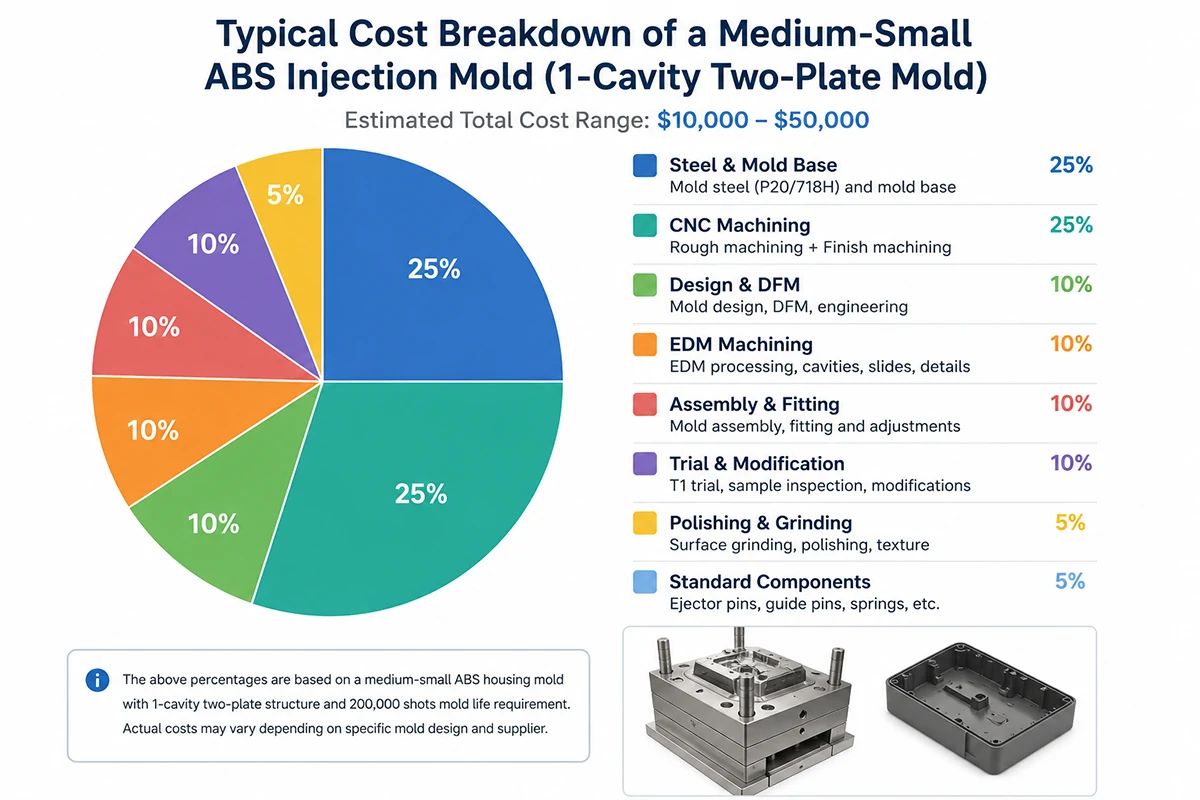
5. Cost Calculation Example: Medium-Small ABS Housing, 1-Cavity Two-Plate Mold
To make the cost structure easier to understand, let’s use a medium-small ABS electronic housing as an example.
1) Product Parameters
The basic product and mold requirements are listed below. These parameters directly affect the mold structure, steel selection, machining difficulty, and final cost.
| Item | Parameter |
| Product | ABS electronic product housing |
| Size | 300 × 200 × 50 mm |
| Material | ABS |
| Mold Structure | 1-cavity two-plate cold runner mold |
| Mold Steel | P20 / 718H |
| Mold Life Requirement | 200,000 shots |
| Tolerance Requirement | ±0.10 mm |
| Surface Requirement | Standard EDM texture / Ra1.6 μm |
| Production Purpose | Low-to-medium volume industrial production |
2) Cost Breakdown
Based on the above requirements, the estimated mold cost can be broken down into the following items.
| Cost Item | Hours / Specification | Reference Rate | Cost Range |
| Mold Design & DFM | 20–40 hours | $50–$150/hour | $1,000–$6,000 |
| Mold Steel & Mold Base | P20/718H, medium-small mold base | Based on specification | $2,000–$6,000 |
| Standard Components | Ejector pins, guide pins, springs, cooling connectors | Based on specification | $500–$2,000 |
| CNC Rough Machining | 20–40 hours | $40–$80/hour | $800–$3,200 |
| CNC Finish Machining | 30–70 hours | $60–$120/hour | $1,800–$8,400 |
| EDM Machining | 10–30 hours | $40–$150/hour | $400–$4,500 |
| Grinding / Polishing | 10–30 hours | $50–$120/hour | $500–$3,600 |
| Assembly & Fitting | 20–40 hours | $50–$120/hour | $1,000–$4,800 |
| T1 Trial & Modification | 1–2 rounds | Based on machine/labor cost | $1,000–$5,000 |
| Project Management & Profit | Inspection, communication, risk reserve | 10%–25% | Included in total price |
3) Estimated Total Cost
- Based on the above breakdown, a medium-small ABS housing mold of this type in North American and European markets is usually quoted at: $10,000–$50,000
- If the structure is very simple and the supply chain cost is relatively low, the price may be close to: $8,000–$15,000
- The price can be raised to: $50,000-$80,000+ if slides, complex surfaces, high polishing, hot runner or higher mold life is required.
6. Quotation Evaluation Guidelines
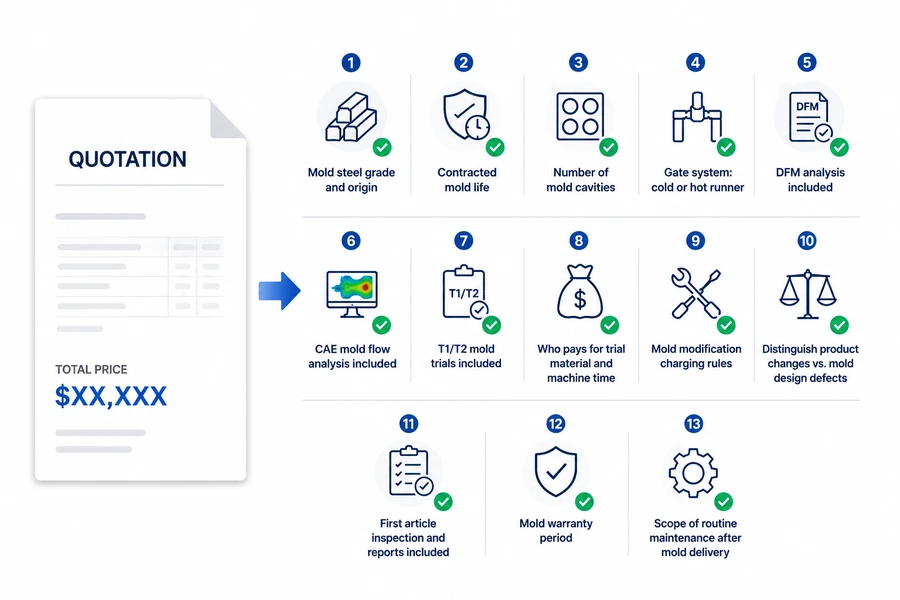
In addition to comparing the final total price, you should also take into account other factors when considering if an injection mold quotation is reasonable. Rather, they should review the terms in detail with a break down of costs.
There are certain terms that must be explicitly mentioned in a professional quotation:
- Mold steel grade and origin;
- Contracted mold life;
- Number of mold cavities;
- Gate system: cold runner or hot runner;
- Whether DFM analysis is included;
- Whether CAE mold flow analysis is included;
- Whether T1/T2 mold trials are included;
- Who pays for trial material and machine time;
- Mold modification charging rules;
- How to distinguish customer product changes from mold design defects;
- Whether first article inspection and dimensional reports are included;
- Mold warranty period;
- Scope of routine maintenance after mold delivery.
An accurate mold quote should include each individual component of the cost of the mold, including material cost, design cost, CNC cost, EDM cost, standard component cost, trial mold cost, reserved modification cost, inspection cost, project management cost, and so on.
Comparing itemized quotation details can make it easier for buyers to see if they have received an over-priced quotation or a quotation that has not included all the items that they need and will avoid any unbudgeted extra expenses that may arise during the project.
7. Conclusion
The cost of injection mold is related to the design, material, machining, precision, mold life and needs of production. It is not enough to just make comparisons, it’s important to get the price breakdown for each quote. To minimize risk, avoid hidden costs and select the right mold cost supplier, you must have a clear understanding of the cost of mold.